


Modern software teams have largely figured out how to ship software fast.
With continuous integration, automated deployments, and cloud-native infrastructure, releasing code daily or even multiple times a day is completely normal now.
But there's still one major challenge that many teams struggle with:
How do you make sure the software actually works every time it gets deployed?
For years, testing happened at the very end of development. Developers would finish building a feature, hand it over to QA, and testers would try to catch bugs before release.
The problem? By the time a bug is discovered at that stage, it's often expensive, disruptive, and time-consuming to fix.
Recent industry surveys from 2026 show a clear shift in how organizations approach quality. More than half of the software teams now involve quality engineers during requirements and design discussions, not just after development is complete.
This shift in thinking has a name: QAOps.
Instead of treating testing as a final checkpoint, QAOps integrates quality throughout the entire software delivery lifecycle.
What Is QAOps?
QAOps is the practice of embedding quality assurance directly into DevOps workflows and CI/CD pipelines.
In simpler terms, it means testing is no longer something that happens only after development. Instead, quality checks happen continuously, from the moment code is written until it runs in production.
In a QAOps environment:
- Developers run unit tests as part of their daily workflow
- QA engineers design automated test suites that run on every code change
- Operations teams monitor production for errors and performance issues
- All teams collaborate to improve software quality
The goal is simple: catch defects as early as possible, when they are the easiest and cheapest to fix.
By the time code reaches production, it has already passed through multiple automated quality gates.
QAOps vs Traditional QA
To understand why QAOps matters, it helps to compare it with the traditional QA approach.
| Dimension | Traditional QA | QAOps |
|---|---|---|
| Testing timing | After development is complete | Continuously, from design through production |
| Team structure | Separate QA team as final gatekeeper | Cross-functional ownership of quality |
| Feedback speed | Days or weeks after code is written | Minutes after every code commit |
| Environment setup | Manual, prone to inconsistency | Automated via Infrastructure as Code (IaC) |
| Defect detection | Late-stage, expensive to fix | Early-stage, cheaper to address |
| Automation level | Selective, often manual-heavy | Comprehensive, test execution is automated |
QAOps vs DevOps: How They Work Together
People often assume QAOps replace DevOps, but that's not the case.
In reality, QAOps build on top of DevOps.
DevOps focuses on speed and reliability of software delivery. It aligns development and operations teams and automates processes like builds, deployments, and infrastructure management.
QAOps extends this by adding continuous quality engineering to the same pipeline.
A simple way to think about it:
DevOps builds the highway. QAOps installs the guardrails.
DevOps ensures software moves quickly through the pipeline. QAOps ensures that nothing unsafe reaches production.
Together, they create a development workflow that is both fast and reliable.
| Aspect | DevOps | QAOps |
|---|---|---|
| Core goal | Faster, more reliable software delivery | Continuous, automated quality assurance |
| Key practices | CI/CD, infrastructure automation, monitoring | Continuous testing, shift-left QA, test orchestration |
| Automation scope | Builds, deployments, infrastructure | Test execution, environment validation, quality gates |
| Team involvement | Dev + Ops alignment | Dev + Ops + QA alignment |
Ready to Implement QAOps in Your Development Pipeline?
Our quality engineering experts help teams embed continuous testing into DevOps workflows so you can release faster without compromising reliability.
Explore our Automation Testing Services
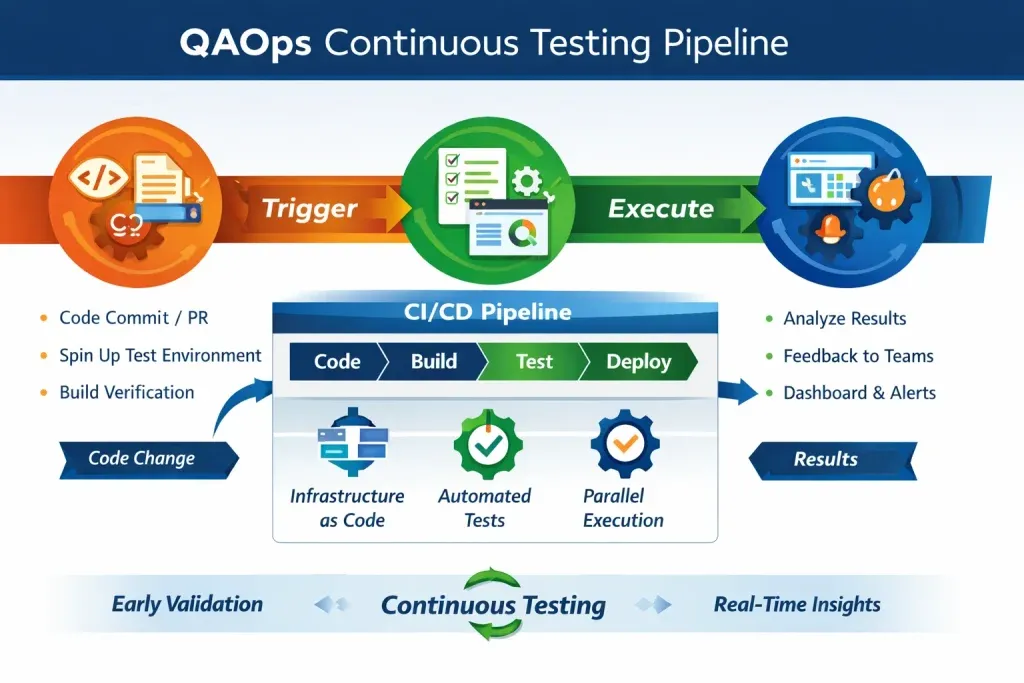
The QAOps Lifecycle
QAOps operates through a repeating cycle that ensures every code change is properly validated.
This lifecycle can be broken into three key phases.
1. Trigger
The QAOps process begins the moment a developer pushes code or opens a pull request.
The CI/CD pipeline detects this change and automatically starts a series of quality checks.
During this phase:
- The system identifies which parts of the code were modified
- Test environments are automatically created using Infrastructure as Code
- The application build is validated to ensure it compiles correctly
Think of this as preparing the stage before testing begins.
2. Execute
Once the environment is ready, the pipeline executes automated tests.
These tests often run in parallel across multiple environments, which allows teams to maintain speed while still achieving high test coverage.
Typical tests include:
- Unit tests
- Integration tests
- API tests
- End-to-end functional tests
- Performance tests
- Security scans
The goal is to identify bugs, regressions, performance issues, or vulnerabilities before the code moves further down the pipeline.
3. Report
After tests are run, the system aggregates results and presents them through centralized dashboards and alerts.
Teams can instantly see:
- Pass/fail rates
- Test coverage metrics
- Defect trends
- Environment health
Failures are automatically routed to the responsible developers so they can act immediately.
Even more importantly, this data feeds back into future development cycles. Teams can identify recurring issues, performance bottlenecks, or areas that need stronger test coverage.
Core Components of a QAOps Framework
A mature QAOps implementation relies on several interconnected practices.
Let's look at the most important ones.
Automated Testing Across Every Layer
Automation forms the backbone of QAOps.
Frameworks like Selenium, Playwright, Cypress, and Appium allow teams to run automated tests across different layers of an application.
These include:
- Unit testing for individual functions
- Integration testing for service interactions
- API testing for backend services
- End-to-end testing for user workflows
The objective is not just reducing manual effort. It's ensuring that quality checks run quickly enough to fit inside modern deployment pipelines.
Parallel Test Execution
Running tests sequentially slows down delivery.
QAOps solves this by running tests in parallel across multiple browsers, devices, and operating systems.
Cloud infrastructure makes this scalable. Hundreds of tests can run simultaneously, drastically reducing feedback time.
However, for parallel testing to work reliably, test cases must be independent and isolated.
Otherwise, shared dependencies can lead to flaky tests.
Shift-Left Testing
Shift-left testing means bringing QA activities earlier into the development process.
Instead of waiting until coding is finished, QA engineers participate in:
- Requirements discussions
- Sprint planning
- Feature design sessions
By identifying potential issues early, teams prevent defects before they even reach development.
This dramatically lowers the cost of fixing bugs.
Infrastructure as Code for Test Environments
One of the most common issues in testing is environmental inconsistency.
You've probably heard the classic phrase:
"It works on my machine."
QAOps eliminates this problem by using Infrastructure as Code (IaC) to define test environments.
Servers, dependencies, networks, and configurations are described in version-controlled scripts. Environments can then be created automatically and consistently for every test run.
This ensures tests always run in environments that closely mirror production.
Continuous Regression Testing
Every new code change carries the risk of breaking existing functionality.
Regression testing ensures previously working features continue to work after updates.
In QAOps, regression tests are automated and triggered with every build, allowing teams to detect regressions within minutes.
Performance and Scalability Testing
Software quality isn't just about correctness; performance matters too.
An application that works perfectly for one user but crashes under heavy traffic still delivers a poor experience.
QAOps pipelines often include performance and scalability testing to validate:
- Response times
- Concurrency limits
- System stability under load
This ensures applications can handle real-world usage scenarios.
Continuous Monitoring and Production Feedback
QAOps doesn't stop when software is deployed.
Production monitoring provides valuable insights into real user behavior, system performance, and unexpected errors.
These signals feed back into development, helping teams prioritize improvements and strengthen test coverage where it matters most.
QAOps Best Practices for 2026
Organizations adopting QAOps have discovered several best practices that consistently lead to success.
Start with a Clear Testing Strategy
Before automating tests, define what quality actually means for your application.
Focus on:
- Critical user journeys
- High-risk system components
- Performance expectations
A well-defined strategy ensures automation efforts to target the areas that matter most.
Automate Strategically
Not every test case needs automation.
Tests that run frequently, like regression or API validation, are ideal candidates.
However, exploratory testing and usability evaluations still benefit from human judgment.
The goal is balanced automation, not automation for its own sake.
Fix Flaky Tests Immediately
Flaky tests undermine trust in the entire testing process.
If developers begin ignoring failing tests because they're unreliable, the entire QAOps system breaks down.
Treat flaky tests as critical issues and resolve them quickly.
Establish Shared Quality Metrics
QAOps works best when everyone shares responsibility for quality.
Common metrics include:
- Deployment frequency
- Defect escape rate
- Mean time to detection
- Automated test coverage
Making these metrics visible across teams encourages accountability and collaboration.
How to Get Started with QAOps
Transitioning to QAOps doesn't happen overnight.
A practical roadmap usually includes:
- Auditing your current testing processes
- Implementing CI/CD pipelines with quality gates
- Automating high-priority test cases
- Using Infrastructure as Code for environments
- Setting up centralized test reporting
- Expanding test coverage iteratively
- Integrating production monitoring feedback
The key is gradual adoption. Start with one pipeline, prove the value, and expand from there.
Final Thoughts
QAOps represents the natural evolution of software testing in a world of continuous delivery.
By embedding testing directly into CI/CD pipelines, teams can:
- Catch defects earlier
- Release software faster
- Improve production reliability
Most importantly, QAOps shifts quality from being a final checkpoint to becoming a continuous engineering discipline shared across the entire organization.
For teams still relying on end-of-cycle QA processes, adopting QAOps can dramatically improve both speed and software quality.