


When users complain that an application feels slow, the real challenge isn't fixing performance; it's proving whether performance is actually acceptable in the first place. Teams often run performance tests and collect metrics, but without a reference point, those numbers don't tell a complete story.
That's exactly where benchmark testing comes in.
Benchmark testing enables teams to evaluate their performance against fixed, meaningful reference points, rather than relying on assumptions or intuition. In 2026, when applications are cloud-based, traffic is unpredictable, and users are impatient, benchmark testing is no longer optional. It's a necessity.
What Is Benchmark Testing?
Benchmark testing is a type of performance testing that measures how an application, system, or website performs against predefined standards, historical baselines, or industry expectations.
In modern performance testing, these benchmarks are often aligned with widely accepted web performance best practices and performance standards for web applications, such as those defined by Google to reflect real user experience and measurable performance quality.
Instead of asking "How fast is my app?", benchmark testing answers:
- Is my app fast enough?
- Is it improving or getting worse over time?
- How does it perform under real-world conditions?
Benchmark testing gives teams context, not just metrics.
Why Benchmark Testing Matters
Performance issues don't usually appear overnight; they creep in gradually with new features, integrations, and traffic growth. Benchmark testing helps catch these issues early.
Key benefits include:
- Validating speed, stability, and reliability
- Identifying performance gaps before users notice
- Supporting confident go/no-go release decisions
- Aligning technical performance with business expectations
In short, benchmark testing prevents "surprise slowness" in production.

Key Aspects of Benchmark Testing
Modern benchmark testing goes beyond basic load testing. In 2026, it focuses on realistic, user-centric performance.
Performance Metrics
Measures response times, load times, throughput, and error rates across APIs, web apps, and mobile apps.
Scalability
Evaluates how well the system handles growing traffic, data volume, and concurrent users.
Cross-Platform Performance
Ensures consistent performance across browsers, devices, operating systems, and screen sizes.
Stress and Peak Load Behavior
Tests how the system behaves during traffic spikes, sales events, or unexpected surges.
Resource Utilization
Monitors CPU, memory, disk I/O, and network usage to uncover bottlenecks.
Real-World Conditions
Simulates actual user behavior, geographic distribution, and network variability.
Benchmark Comparison
Compare current results with past releases or industry standards to spot regressions or improvements.
User Experience Impact
Focuses on how performance affects real users, page responsiveness, interactivity, and perceived speed.
Examples of Benchmark Tests
Here are common benchmark tests used in modern performance testing:
1. Page Load Time Benchmark (Websites)
Measures how quickly pages load and become usable for users.
Metrics: TTFB, LCP, TTI, total load time
2. API Performance Benchmark (Web & Mobile Apps)
Evaluates API responsiveness under different loads.
Metrics: Response time, throughput, error rate
3. Mobile Performance Benchmark
Tests performance across real mobile devices and screen sizes.
Metrics: Load time, layout stability, interaction delays
4. Stress Benchmark
Pushes the system beyond normal limits to identify failure points.
Metrics: Stability, recovery time, resource saturation
5. Cross-Browser Benchmark
Ensures consistent performance across Chrome, Firefox, Safari, and Edge.
6. Database Benchmark
Measures query execution time and connection stability.
Metrics: Query latency, throughput
7. Load Benchmark
Simulates normal user traffic to validate day-to-day performance.
Types of Benchmark Tests
Different systems require different benchmarking approaches:
- System benchmarking – The entire system, including hardware, software, and network
- Application benchmarking – Web apps, APIs, mobile apps, databases
- Hardware benchmarking – CPU, memory, GPU, storage
- Network benchmarking – LAN, WAN, bandwidth, latency
- Storage benchmarking – HDDs, SSDs, cloud storage
A clear test plan is essential before running any benchmark.
Performance, Load, Stress, and Scalability Benchmarks
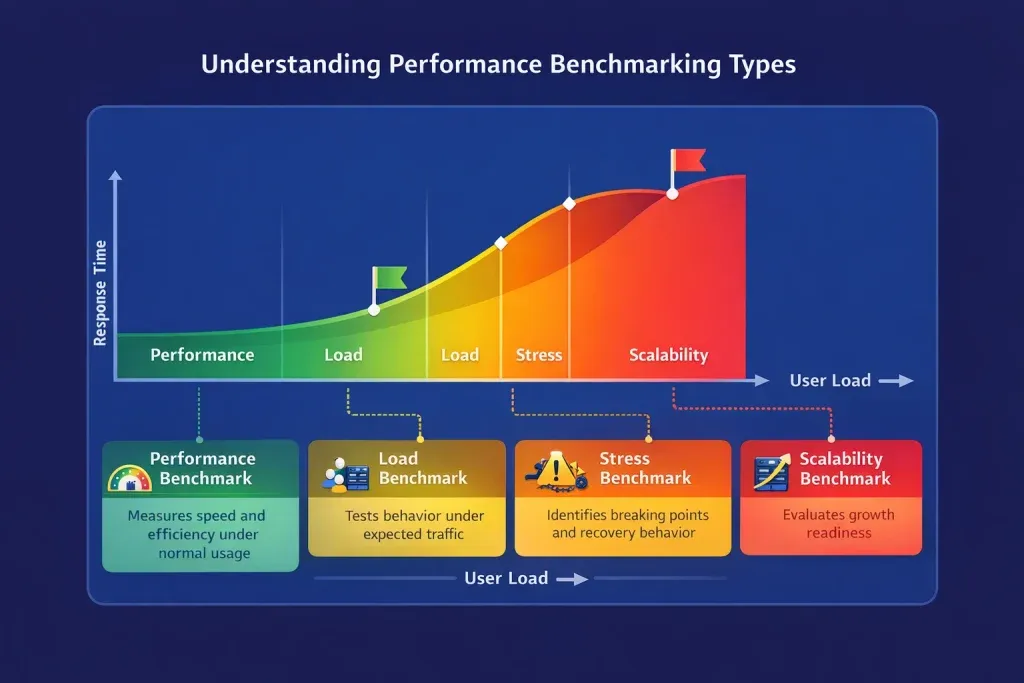
To understand application performance beyond just speed, teams rely on different types of benchmarks that evaluate how systems behave under normal usage, peak traffic, extreme stress, and future growth scenarios.
- Performance benchmarking – Measures speed and efficiency under normal usage
- Load benchmarking – Tests behavior under expected traffic
- Stress benchmarking – Identifies breaking points and recovery behavior
- Scalability benchmarking – Evaluates growth readiness
Together, these benchmarks provide a complete performance picture.
While these benchmark types are closely related, each serves a distinct purpose in performance evaluation. Understanding the differences between them helps teams apply the right benchmarking approach at the right time, as explained in detail in the comparison of performance testing, load testing, and stress testing.
When Should You Use Benchmark Testing?
Benchmark testing is useful at multiple stages:
- During development, to validate new features
- Before releases, to ensure performance stability
- After infrastructure changes or cloud migrations
- As part of ongoing performance monitoring
- When users report slowness or instability
In modern agile teams, benchmarking is continuous, not one-time.
Need Reliable Performance Benchmarks for Your Application?
We help teams establish realistic performance benchmarks, identify risks early, and release with confidence using proven performance testing strategies.
Get Started with Performance Testing
Core Components of Benchmark Testing
A reliable benchmark test includes:
- Test environment – Production-like hardware, software, and network
- Test data – Realistic and consistent datasets
- Test plan – Objectives, scope, metrics, and assumptions
- Benchmarking tools – Load, performance, and monitoring tools
- Reports – Clear insights and optimization recommendations
How to Perform Benchmark Testing
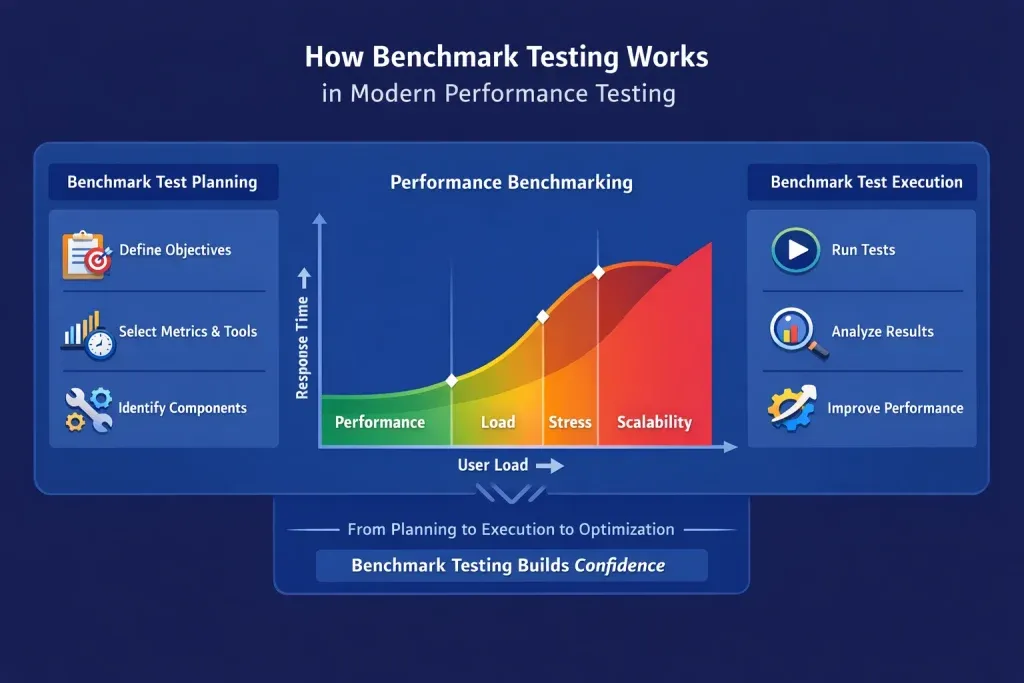
Step 1: Create a Benchmark Test Plan
- Define objectives
- Identify components to test
- Select metrics (response time, throughput, latency)
- Choose suitable tools
Step 2: Execute the Benchmark
- Set up the environment
- Prepare test data
- Run tests consistently
- Analyze results
- Document findings and recommendations
Benchmarking vs Benchmark Testing
| Aspect | Benchmarking | Benchmark Testing |
|---|---|---|
| Scope | Strategic & comparative | Technical & execution-focused |
| Focus | Best practices & standards | Performance metrics |
| Duration | Ongoing | Test-cycle based |
| Usage | Business & planning | QA & engineering |
Factors That Affect Benchmark Results
Benchmark outcomes can be influenced by:
- Network conditions
- Hardware capacity
- Traffic volume
- Code optimization
- Caching behavior
- Test environment setup
- Third-party integrations
- Device and browser variability
- CDN usage
- Testing methodology
Controlling these factors improves accuracy.
Challenges While Performing Benchmark Testing
Challenge: High setup time
Solution: Start with critical user journeys and automate tests
Challenge: Cost and infrastructure needs
Solution: Use cloud-based testing platforms
Challenge: Unrealistic test scenarios
Solution: Benchmark using real devices and networks
Challenge: Over-optimizing for scores
Solution: Combine benchmarks with real-user monitoring
Conclusion
Benchmark testing plays a vital role in performance optimization. It gives teams the baseline they need to understand performance changes, validate improvements, and prioritize optimization efforts.
When done consistently, benchmark testing helps identify bottlenecks early, reduces production risks, and ensures applications remain fast, stable, and reliable, no matter how user demand evolves.
In 2026, benchmark testing isn't just about measuring performance.
It's about maintaining performance confidence at scale.